Friday, March 17, 2017

Peru Mass Wasting

Peru has experienced many types of mass wasting. Mass wasting is large movement of rock, soil and debris downward due to the force of gravity(Study). Unfortunately, over the years sorry has come into contact with landslides, mudslides, and avalanches. One of the most known mass wasting events in Peru was the avalanche that occurred in 1970. The avalanche started as a sliding mass of glacial ice and rock. The avalanche swept about 16.5 km to the village of Yungay at a speed of 210-280 km/h(NDGC).
      

Peru is currently experiencing one type of mass wasting right now which is mudslides. Recently, there has been flooding in Peru which is resulting in a mudslides. The new floods and mudslides over the past three days followed a series of other storms, and officials said a total of 62 people have died and 12,000 homes have been destroyed so far this year(CBSnews).
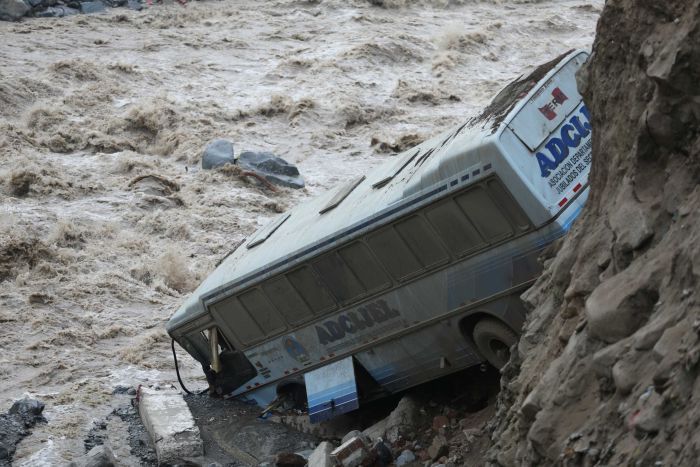

When searching for ways Peru has been preventing or alerting Peruvians, there was little to no information. What is upsetting is that Peru is a country with poverty to where they only have some resources given when it comes to natural hazards, and mass wasting is not one of them. Although it is tough, Peru should create more ways into helping those who are being impacted by mass wasting so we see less damage and casualties.


References
http://study.com/academy/lesson/mass-wasting-definition-types-causes-processes.html
https://www.ngdc.noaa.gov/hazardimages/picture/show/785
http://www.cbsnews.com/pictures/peru-flooding-mudslides-deadly/


Friday, February 24, 2017

Volcanoes

When it comes to volcanoes in Peru, there are multiple along and close by the coast. Peru's volcanoes belong to the subduction zone of the eastern Pacific Nazca plate beneath the South American plate (Volcano Discovery).

The image below is the stratovolcano Ubinas, which is Peru's most active volcano. Ubinas is composed of Pleistocene, and has a 1.2-km-wide caldera that cuts across the top of the volcano. .


Many of the volcanoes in Peru are active. Since they are active, Peru has information on high level hazards to be safe due to activity from volcanos. According to Think Hazard, they recommend the people of Peru take action on early warning signs of an eruption. By clicking this link, http://www.thinkhazard.org/report/195-peru/VA,  there will be a list of precautions taken by the country to stay protected during any event that is damaging.


volcanodiscovery.com/peru.html
http://www.thinkhazard.org/report/195-peru/VA
http://volcano.oregonstate.edu/ubinas

Friday, February 10, 2017

Seismicity of Peru


In this weeks chapter we learned about earthquakes. Since Peru is located near a subduction zone, it's more likely to experience many earthquakes. They are more common for the fact that the Nazaca and South American plate are by the Peruvian Coast. 

We also learned about seismicity, which is a happening of earthquakes in a region. The seismictiy in Peru goes from increasing from inland to the Peruvian coast. This week has been somewhat active. Two days ago there was an earthquake near Coracora and Ayacucho, Peru that was 5.1 in magnitude. Also, today there was one near Paracas and Ica that was 4.2 magnitude (Earthquake Track).


Even though it is hard to predict earthquakes, Peru now has two ways of dealing them using the American Red Cross and Peruvian National Institute of Seismology that say "drop, cover, and hold on", or the American Rescue Team International that uses "The Triangle of Life Method" (LimaEasy). It is also recommended to stay calm and to stay in a safe place if you are indoors.


Sources:
 http://earthquaketrack.com/p/peru/recent
http://www.limaeasy.com/earthquakes-in-peru/earthquakes-info

Friday, February 3, 2017

Peru and Plate Tectonics


In week two, we learned about the Earth's tectonic plates. The words tectonic refers to large-scale geological processes that deform Earth's lithosphere (Keller). With the plates being broken down all over earth taking part of a continent and section of water, I located Peru to see what plate it was placed on.
Being part of the ring of fire, Peru is located on top of the South America plate boundary and south of that is the plate Nazca. Because the Nazca plate moves east towards the South American plate, that makes it convergent boundary. According to Keller, a convergent boundary is when two plates are moving towards one another.

Since Peru is near the Nazca plate and on the South America plate, it is prone to most earthquakes that occur around the world. Due to subduction, we see more shallow earthquakes closer to the subduction zone and deeper ones inland (IRIS).

Peru also is more likely to experience tsunami's because of the activity of the Peru-Chile trench. In 2001, Peru had an earthquake of 8.3 which created a tsunami off the Peruvian coast where damage occurred. (USC Tsunami Research Group).


References:
https://www.iris.edu/hq/inclass/animation/peruchile_subduction_zone_earthquakes__tectonics
http://www.usc.edu/dept/tsunamis/peru/
Natural Hazards, Keller, 4th Edition.

Sunday, January 29, 2017

Natural Hazards, Catastrophes and Disasters

     When it comes to talking about natural hazards, catastrophes and disasters, most of us do not realize the differences between the three. For myself, I never had the knowledge of knowing the differences until now. They all start with qualifications of how hazardous the event is, and from there it is placed into a certain category. A natural hazard is an event taking place to where it has the opportunity to threaten then lives around the area; examples being, tsunami's, hurricanes, flooding, etc. A catastrophe is an occurrence where a great disaster that has cause enough damage that requires years of recovery, plus a lot of money. Disaster is a hazardous situation where it happens in a limited time and more that ten people are killed and more than one-hundred people were affected by it. Disasters also require a lot of assistance to those who were harmed. An example of a disaster would be the 2012 Hurricane sandy event, where more than one-hundred people were killed and thousands were injured . There is a significant difference between the three, and I believe it is beneficial for us to know them and about what makes them different from each other.